
Planning
Window Condensation in Winter: Fix or Replace? Bellevue, WA
Water on your windows this winter? Learn to tell humidity from a failed seal, what to fix first, and when replacing windows in Bellevue is worth it.
By Shawn, True Level Remodeling阅读中文版
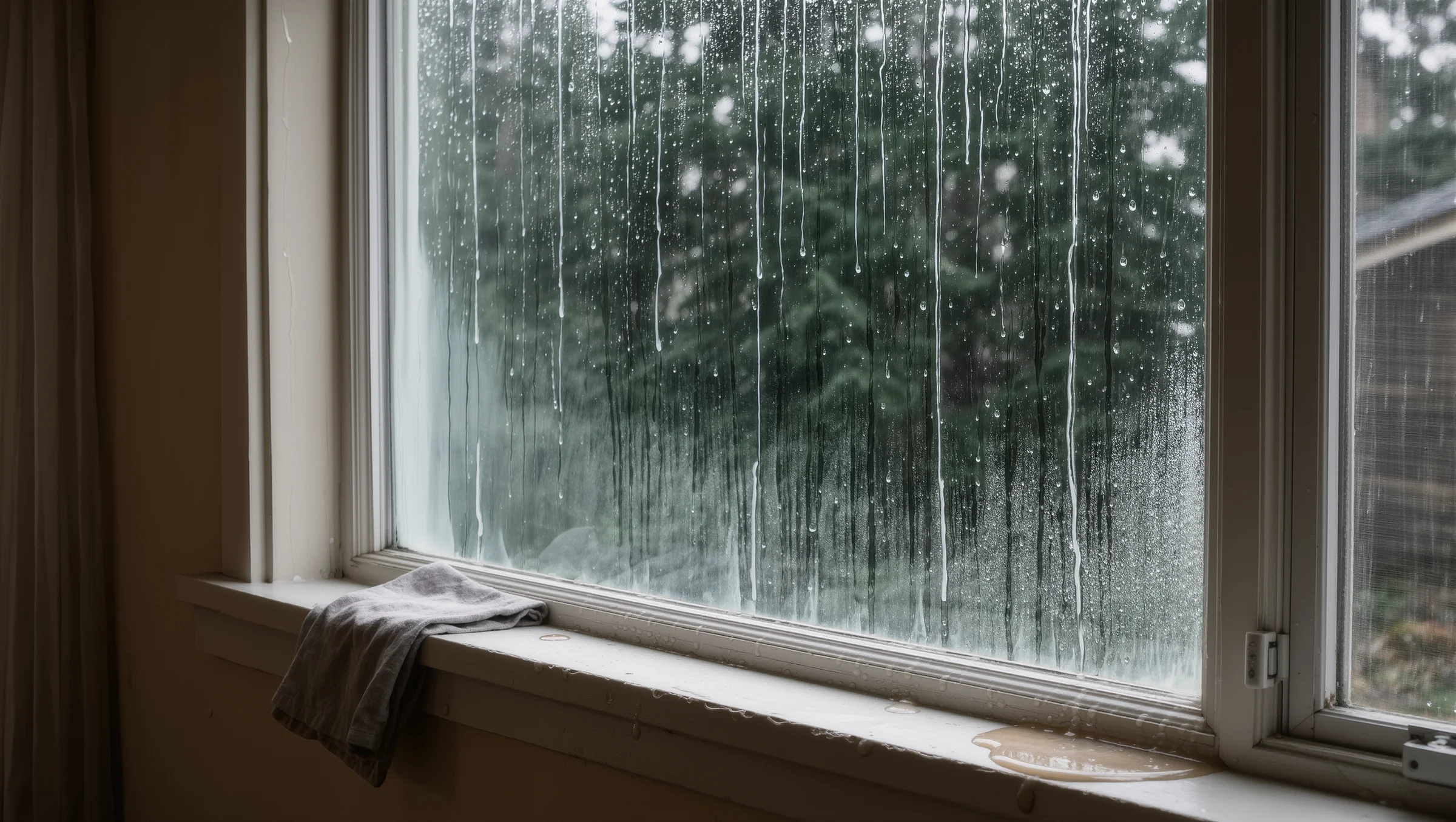
If the water is on the room side of the glass, your windows are usually fine. The air inside is too humid, so lower the humidity first. If the fog is between the two panes, the window’s seal has failed. No amount of drying out the house will clear it, and the fix is new glass or a new window.
So the first step in a Bellevue winter is to look closely. Find out where the water sits, then decide.
Where is the condensation, and what does it mean?
Wipe the glass on the inside. If it comes off on the cloth, the moisture is on the room side. If the haze stays, it is trapped inside the glass unit.
| Where you see it | What it usually means | What to do first |
|---|---|---|
| Room side of the glass, worst in the morning | Indoor humidity is high for how cold the glass is | Measure humidity and lower it |
| Between the two panes; won’t wipe off | The insulated glass seal has failed | Plan to replace the glass unit or the window |
| Outside surface, on cool clear mornings | Normal on efficient glass; the outer pane stays cold | Nothing; it burns off |
| On metal frames, dripping onto the sill | Cold aluminum frames, often in older homes | Lower humidity; consider replacing |
Window maker Andersen puts it plainly: condensation on the inside forms “because the humidity level is too high indoors, not because there is something wrong with the window,” while condensation between the panes is “a sign that the seal on your window has failed” (Andersen, Window Condensation 101, checked November 2026).
Why do windows sweat more in a Bellevue winter?
Condensation forms when warm, moist indoor air touches a surface colder than its dew point, and in winter the coldest surface in most rooms is the window. Our winters are not very cold, but they are long, gray and damp, and the house stays closed for months. Moisture builds up from:
- Showers and baths, especially without a working exhaust fan
- Cooking, above all steaming, boiling and stir-frying without a range hood vented outside
- Drying laundry indoors, or a dryer vent that is loose or blocked
- People breathing in closed bedrooms overnight; this is why bedroom windows are often the worst
- Houseplants, aquariums and stacks of firewood stored indoors
Older windows make it worse. Single-pane glass and aluminum frames, which are common in homes built before the 1980s, get much colder than modern double-pane vinyl or fiberglass windows. They start to sweat at humidity levels a newer window would handle without trouble.
How do you lower indoor humidity first?
Try this for one to two weeks before you price new windows. It costs little and often solves the problem.
- Buy a hygrometer. An inexpensive one tells you where you stand. The U.S. EPA recommends keeping indoor humidity below 60 percent, ideally between 30 and 50 percent (EPA, A Brief Guide to Mold, Moisture and Your Home, checked November 2026). Window makers suggest the lower end in cold weather; Andersen recommends aiming for 30 to 35 percent in winter.
- Run exhaust fans longer. Keep the bathroom fan on for 20 to 30 minutes after a shower, and use the range hood every time you cook. If a fan barely moves a tissue, it is not doing its job.
- Check the dryer vent. It should go outside, with a flap that opens when the dryer runs.
- Open blinds and curtains during the day. Heavy curtains trap cold air against the glass and make condensation worse.
- Run a dehumidifier in the dampest room, often a basement or a bedroom on the north side.
- Keep the heat steady. Letting rooms get very cold overnight makes the glass colder too.
- Watch for mold. Wipe up water each morning. Black spots on sills or in the corners of the frame mean water has been sitting there for a while.
If the room-side condensation goes away, you have your answer. If the house is at 35 to 40 percent and the windows still stream every morning, the windows themselves are part of the problem.
When is replacing the window the right fix?
Replacement makes sense when the window, not the air, is the cause. Signs to look for:
- Fog or white haze between the panes that never clears
- Single-pane glass that sweats even at moderate humidity
- Aluminum frames that drip onto the sill every cold morning
- Soft, dark or crumbling wood at the sill or the bottom of the sash
- Drafts you can feel with your hand, or windows that no longer lock or seal
- Mold that keeps coming back after you’ve brought the humidity down
Replace only the glass, or the whole window?
If the frame is sound and only the seal has failed, a glazier can often replace just the insulated glass unit (IGU) and keep the frame. It is usually the cheaper option and the right one for a fairly new window. Check the warranty first; many manufacturers cover seal failure, sometimes for a long time.
Replace the whole window when the frame is rotting, warped or aluminum, when several windows are failing at once, or when you want a real gain in comfort and energy use. New glass in an old aluminum frame still leaves you with a cold frame that sweats.
Can you replace windows in a rainy Bellevue winter?
Yes. A same-size replacement is done one opening at a time, and each opening is usually closed up the same day, so the house is never open to the weather for long. Rain changes how the work is done more than whether it can be done:
- Remove one window at a time and keep the opening covered if a shower moves through.
- Check the rough opening for rot and water damage, and fix the framing before the new window goes in.
- Install a sloped sill pan and flash the sides and head so water drains out, not into the wall.
- Seal and insulate the gap around the frame, then finish the trim inside and out.
- Leave exterior caulking and paint for a dry spell if the rain is heavy; most sealants list a minimum temperature and need a dry surface.
Windy, driving rain is a reason to reschedule a day; ordinary drizzle usually is not. Winter has one advantage: you can see exactly which windows sweat and leak, so the choice of what to replace is clear.
Do you need a permit, and what must new windows meet?
In Bellevue, a same-size swap usually needs no permit. The city’s permit FAQ says: “No permit is required for replacements of the same size in the same location.” A permit with plan review is required for “installing or moving an exterior door, skylight or window, including making an existing window wider” (City of Bellevue, Work Requiring Permits, checked November 2026). Our Bellevue permit guide covers the rest.
Permit or not, replacement windows still have to meet the state energy code. The Washington State Energy Code says replacement windows must meet the U-factor in Table R402.1.3 (WAC 51-11R-50300, section R503.1.1.1). That table sets a maximum U-factor of 0.30 for windows (WAC 51-11R-40213, both checked November 2026). Lower is better. Look for the NFRC label on the glass and check the U-factor before you buy.
Frequently asked questions
Will new windows stop all condensation? No. They greatly reduce it because the inner pane stays warmer, but a very humid room will still fog even the best glass. New windows plus sensible humidity is the combination that works.
Can fog between the panes be fixed without replacing the glass? Some companies drill and “defog” the unit, but that only removes the haze. The insulating gas is gone and the seal is still broken. Replacing the glass unit or the window is the lasting fix.
Is window condensation harmful? A little water in the morning is not an emergency. Water that sits on sills day after day can cause mold, peeling paint and rot in the sill and the wall below it, so wipe it up and deal with the cause.
Get your windows looked at
We give free on-site estimates for window and door replacement in Bellevue and the Eastside. We’ll look at the glass, the frames and the sills, tell you plainly whether lower humidity, new glass or new windows will solve the problem, and give you a written, itemized quote. If damp is a problem lower in the house too, see is your basement dry enough to finish. Request your free estimate.